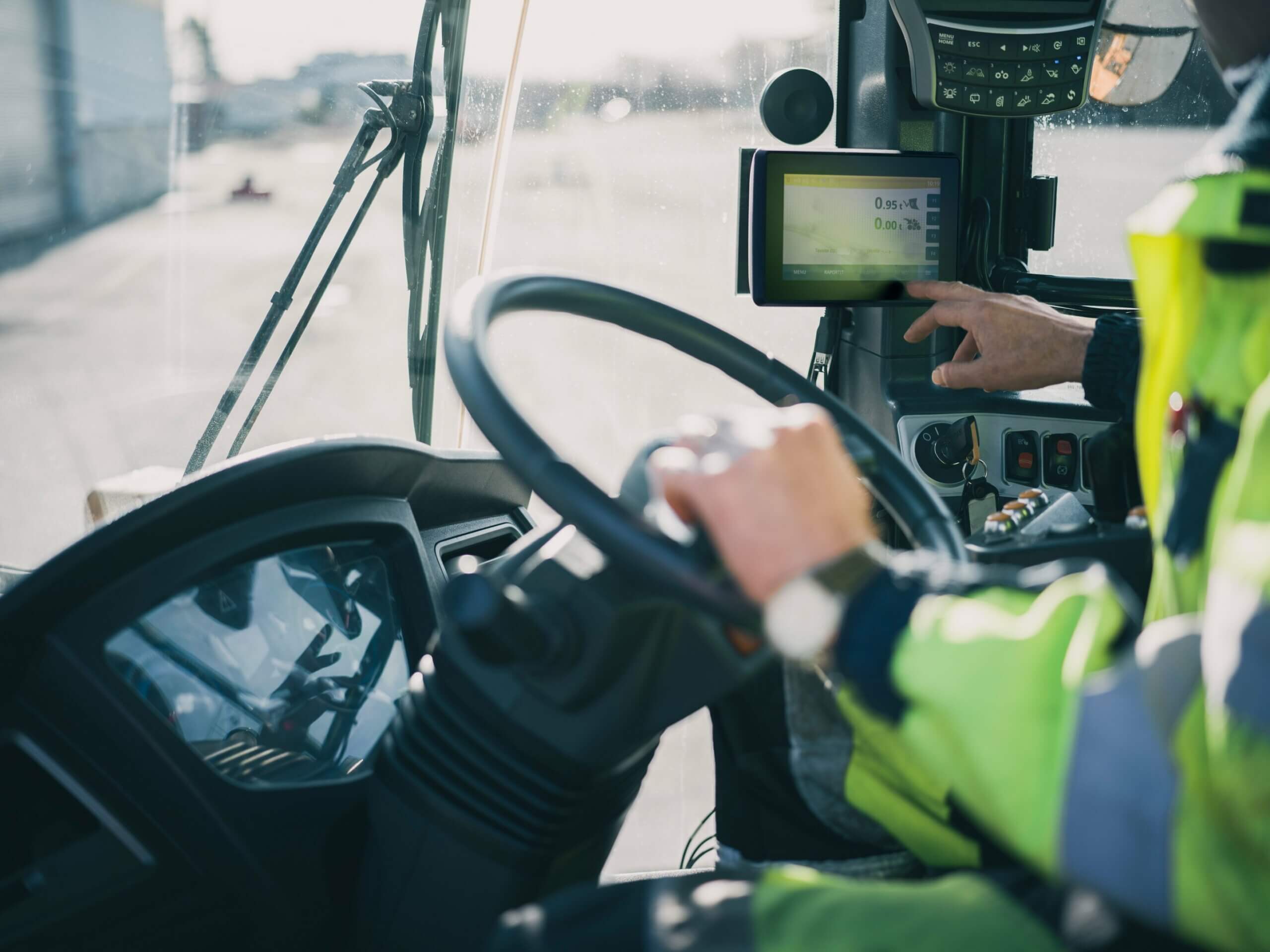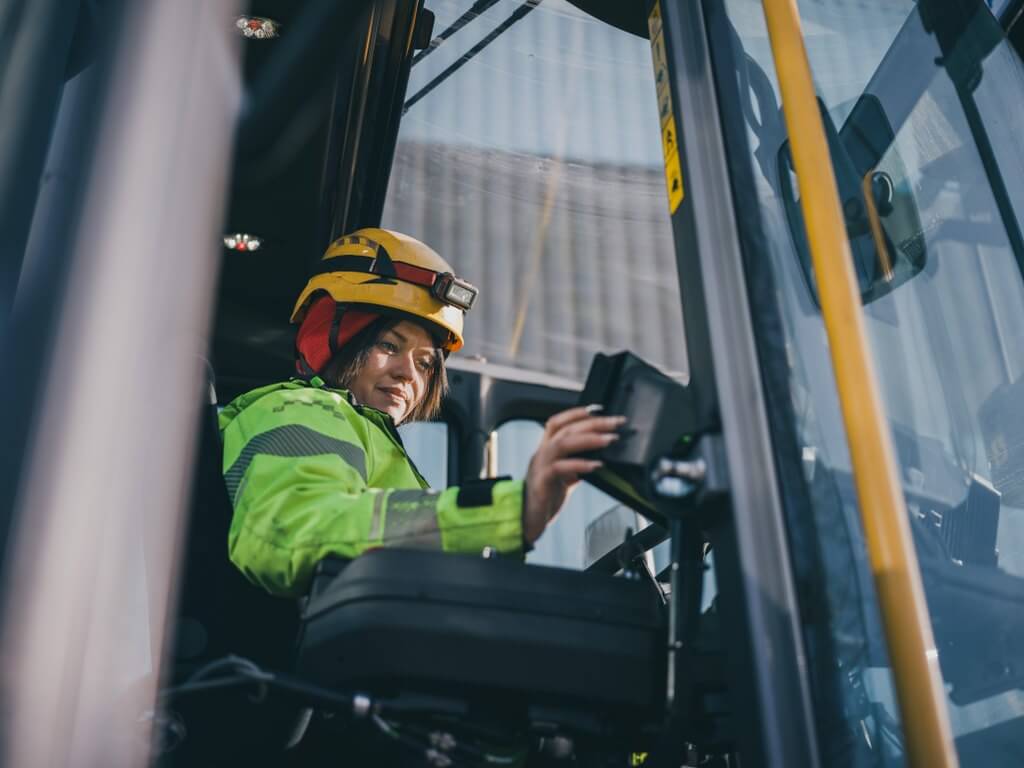
What will the mobile work machine of tomorrow look like? Imagine a machine equipped with AI-powered computer vision that continuously monitors its operating environment and can alert the operator if something unexpected enters the work area — such as a person, an animal or stray objects.
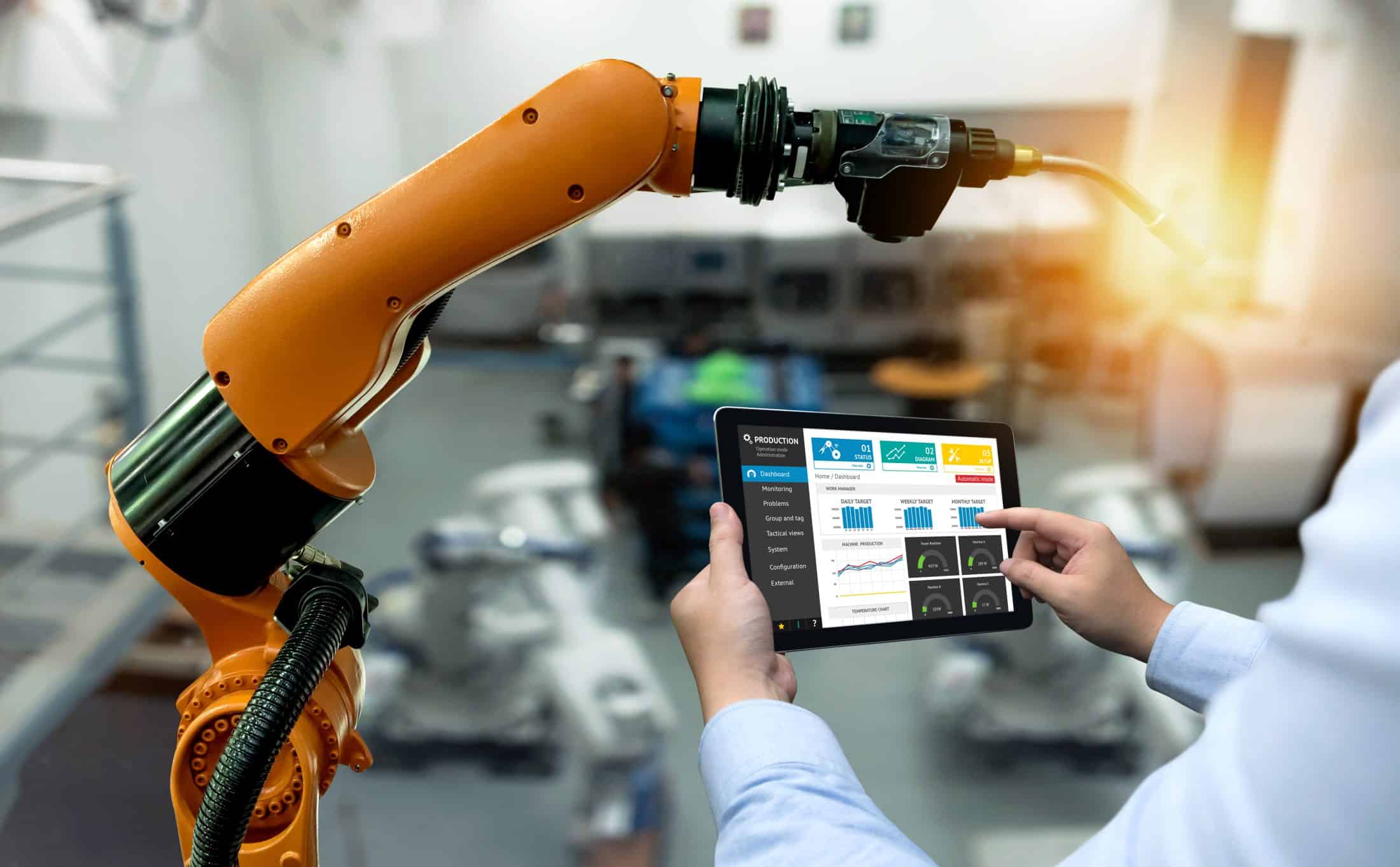
Future work machines will be highly refined computers. Their technological solutions will make operations more efficient, safer and more sustainable. At the same time, their use generates data that creates new data streams and opens up entirely new business opportunities.
In autumn 2025, Gofore entered into a partnership agreement with the international Qt Group. Even before the agreement was signed, the two companies had already showcased their collaboration at the iVT Expo in Germany. Gofore presented an AI-enhanced computer vision solution integrated into a forklift and log loader simulator, with virtual vision installed on both sides of the boom.
The result is visualised data displayed directly on the operator’s screen, offering a real-time view of the machine’s working environment.
The immersive demo attracted well-deserved attention at the international trade fair.
– From a technological perspective, the demo is unique. From the initial idea to practical implementation, the way the team succeeded in bringing genuinely new thinking to future work machines — while solving real, present-day customer challenges — is truly impressive. I and the entire Qt team are proud of the solution, and I am very much looking forward to the future of our collaboration,” says Lazo Eric, Director of Embedded R&D at Qt Group.
Creating new value-driven solutions for the world of mobile machinery
User interfaces play a critical role in the development of intelligent industrial devices and products. The role of displays is becoming increasingly important, and end-user expectations for display graphics continue to rise.
Gofore leverages Qt Group’s software libraries and UI development solutions to create visually compelling graphical user interfaces for industrial use.
Expectations for the newly launched collaboration are therefore high on both sides.
– Qt is one of the most significant technologies in the field of user interfaces for intelligent machines. Rather than developing solutions in silos, we have consciously chosen to draw strength from collaboration. The most tangible benefits of partner agreements are realised by our intelligent industry customers. Together with our partners, Gofore is involved in implementation and design work on the user interface side as well, explains Tomi Vahtera, Service Owner for Embedded Systems at Gofore.
A new era of product development
Many long-established principles of industrial operations — some dating back hundreds of years — are now being challenged. There are several reasons for this, including increasingly demanding customer expectations for faster product development, tightening regulation, and new service-based business models built on high-quality data.
A product’s digital lifecycle now begins at the design stage, which itself is carried out digitally, without the need for heavy physical prototyping phases.
Simulation plays a central role in this digital lifecycle approach. It allows the functionality of a design to be tested before a device or machine enters production. Displays and control panels are a critical part of this functionality.
– Simulation is essential when validating designs before manufacturing. Displays and control panels play a key role in overall usability, Vahtera summarises.
Simulation plays a central role in this digital lifecycle approach. It allows the functionality of a design to be tested before a device or machine enters production. Displays and control panels are a critical part of this functionality.
Lazo Eric agrees and adds:
– The key is to jointly deliver technological solutions that make our customers’ lives easier and improve productivity — from early user interface concepts and quality assurance through to launch and ongoing development.
Looking ahead: Direction for embedded systems the coming years
Lazo Eric, Director of R&D at Qt Group, if you look a few years ahead, what kind of changes do you see in the field of embedded systems?
– The growth in both the number and the role of AI and AI assistants is undeniable. Agentic AI that supports developers, designers, testing and different phases of software development is clearly on the rise.
– Edge AI must also be capable of making decisions — or at least decision proposals — exactly when they are needed. At the moment, many AI models are fragmented, but cross-platform development will evolve here as well. Future AI functionalities will increasingly be built directly into devices.
– Other technologies worth keeping an eye on include solutions originating from the automotive industry. End users expect more from vehicles than ever before. The same trends towards ease of use and enhanced visual experiences in user interfaces are also evident in consumer electronics, as well as in products and solutions for the pharmaceutical, healthcare and defence industries.
Finally, Eric highlights robotics and increasingly sophisticated, immersive virtual solutions as key components of the future technology stack.
Partner spotlight: Qt Group
At the core of Qt Group’s offering are cross-platform solutions that support the entire software development lifecycle.
Cross-platform development makes it possible to deploy the same application across multiple platforms without modifying the underlying source code. The benefits are particularly significant in embedded systems, where applications can be developed for multiple systems and hardware configurations without having to rebuild the software from scratch each time.
Another major commercial strength of Qt lies in display graphics. Their importance continues to grow in professional industrial and defence solutions, as well as in consumer markets.
Listed on the Helsinki Stock Exchange, Qt Group traces its origins back to 1995. Over more than 20 years, the company has grown into an international software house. Its solutions, applications and smart devices are used daily by over 1.5 million software developers worldwide, serving end users across more than 70 industries in over 180 countries.
The machine and device industry is on a journey towards digital service business, seamlessly combining the digital and real worlds. Have you already adopted the Digital Product Lifecycle thinking?