Autonomous manufacturing is more than a technological shift. It is a business transformation where people, data, and technology come together to create sustainable value. Success does not come from automation alone, but from an organization’s ability to strengthen collaboration between people and intelligent systems.
Industrial companies have spent decades improving efficiency through automation and digitalization. Today, that is no longer enough. Production systems are increasingly expected to understand what is happening, support better decisions, learn from outcomes, and adapt to changing conditions.
In my work, I often hear autonomous production discussed as a future destination. Yet I rarely hear the conversation focus on the path itself. Moving towards autonomy is not a single project or technology upgrade. It is a gradual process where organizations become more autonomous in their operations.
As production systems mature, the role of people evolves as well. The focus shifts from monitoring and reacting towards improving, guiding, and continuously developing operations. This human dimension is just as important as the technological one.
Understanding the Journey
The model below shows a simplified view of how manufacturing can evolve towards greater autonomy. In practice, different parts of the same organization often progress at different speeds.
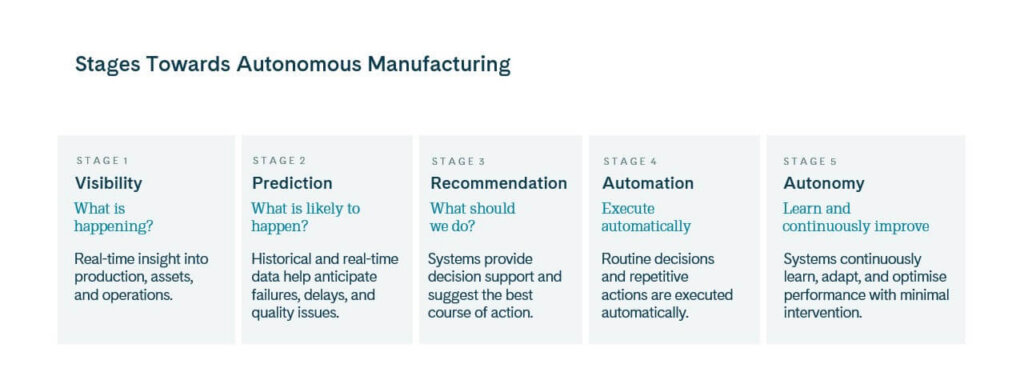
Simplified Autonomous Manufacturing Journey*
Few manufacturers fit neatly into a single stage. Most organizations combine elements of multiple stages, making progress less about reaching a target state and more about identifying the next meaningful step.
Technology enables autonomy, people create the value
Technologies such as AI, digital twins, robotics, and industrial data platforms can enable autonomy, but they do not create it on their own. At every stage of the journey, people need to understand, trust, and use the information these systems provide.
As systems take on more routine analysis and decisions, people can focus more on expert work: problem-solving, innovation, and continuous improvement. This matters especially now, as many industrial companies are already struggling to attract and retain skilled workers.
The goal is not to remove people from production, but to design work so that people and technology each contribute where they create the most value.
Autonomy is built together with production teams
One of the biggest misconceptions about autonomous manufacturing is that people become less important as systems become more capable. In practice, autonomy often increases the importance of human expertise rather than reducing it. Operators, maintenance specialists, engineers, and production managers understand the realities of production better than anyone else.
Organizations that successfully advance towards autonomy involve these stakeholders from the very beginning. In my experience, some of the most valuable insights emerge when operators and production teams are involved early in shaping future processes, tools, and ways of working. Their practical understanding of daily operations often highlights opportunities, risks, and improvement ideas that are difficult to uncover through data alone.
Early involvement helps organizations:
- Identify the right problems to solve
- Design solutions that work in real production environments
- Build trust in new ways of working
- Clarify what people do and what systems do
- Accelerate adoption and learning
Autonomy should be guided by business value
As organizations move towards greater autonomy, the discussion should not focus only on what can be automated. It should also ask what kind of work, operations, and business value autonomy helps create.
Industry 5.0 adds a useful perspective to this discussion. While Industry 4.0 focused on connectivity, automation, and efficiency, Industry 5.0 puts more emphasis on people, resilience, and sustainability.
What next?
Understanding the stages of autonomy is only the starting point. The harder question is what to do next: where to focus, how to involve people, and how to improve productivity without losing sight of resilience and sustainability.
As you consider your next step towards autonomy, ask:
- What is the next logical step for your operations?
- Are operators and production teams involved in shaping the transformation?
- Where can better information improve decisions?
- How can technology and automation support better decisions?
- Are resilience and sustainability being considered alongside productivity?
Autonomous manufacturing is not something organizations simply reach one day. It develops through learning, adaptation, and collaboration between people and technology. The organizations that succeed will be those that keep improving how work is done, how decisions are made, and how value is created.
Take the next step with industry 5.0
Our Industry 5.0 white paper explores how manufacturers can navigate this transformation while keeping people at the center of change.
* The presented maturity journey is inspired by this article: Mo, F., Monetti, F.M., Torayev, A. et al. A maturity model for the autonomy of manufacturing systems. Int J Adv Manuf Technol 126, 405–428 (2023).