What if you could cut product development time in half and drastically reduce the cost of physical prototypes? What if you could remotely diagnose issues in field devices and reliably test new product updates automatically before deployment?
Products are becoming increasingly complex. Software now plays a larger role, and the level of device digitalisation continues to grow. As a result, testing every possible product variation with traditional methods is impractical. In many cases, it slows down the entire development process.
At the same time, external pressure is mounting. European machine and device manufacturers face increasing pressure as competition intensifies, quality standards remain uncompromising, and time-to-market becomes more critical than ever.
A digital twin – a virtual model of a physical environment or device – helps companies create better products faster, more efficiently, and more sustainably. At the same time, it is transforming product development, manufacturing, maintenance operations, and lifecycle management. Digital twins can be used to develop products, perform fault diagnostics, test new software or features, plan updates and maintenance activities, and design entirely new product generations.
But how can the digital dimension of a product actually be utilised across different stages of the product lifecycle? And how does the R&D function benefit from it?
1. Concept design: From abstract ideas to structured plans
Product design begins with a virtual concept. Using simulation tools, companies can evaluate whether the product’s performance, environmental impact, manufacturability, and business model meet the defined requirements. The model is built by combining existing components and adding new ones at the required level of detail.
This lightweight concept helps determine whether product development should proceed or whether the idea should return to the drawing board for further iteration. A digital model also improves transparency between different stakeholders in the organisation from day one.
When digital twins are utilised during the concept phase, product development no longer starts with an idea alone, but with a data-driven and simulated model. This shifts the focus of development from experimentation to validation.
When digital twins are utilised during the concept phase, product development no longer starts with an idea, but with a data-driven and simulated model.
2. Research and Development: Functional and validated solutions
Once the product concept is approved, development moves into the R&D phase, where the digital twin evolves into a virtual prototype. The work completed during concepting is not lost; instead, the model is enriched further. The virtual prototype can be used extensively for development and testing long before a single physical prototype is manufactured.
The digitalisation of product development offers massive benefits when new design principles are implemented at scale. The most important advantages include:
- fewer iteration cycles and shorter time-to-market
- earlier critical decision-making (front loading)
- fewer physical prototypes and lower costs
- improved testability and higher product quality
But what actually changes compared to the traditional approach?
Product development based on a virtual prototype relies heavily on simulation and model-based engineering methods. Product design, mechanical engineering, hydraulics, electronics, and software development are all carried out using the same virtual prototype. The same prototype is also used to test device functionalities and serve as a foundation for digital services.
3. Manufacturing: High-quality physical products
The journey of the digital model continues from the customer journey and product marketing all the way to manufacturing the ordered product. This process – together with automated configuration management – forms an essential part of the product’s digital lifecycle.
The manufactured product receives its digital “birth certificate” when a complete digital copy is created from the actual product built at the production facility. At this stage, order information, product data, and the correct software are combined into the exact ordered product configuration. As production data emerges, it becomes linked to the product’s digital twin. This gives product development teams concrete feedback on manufacturing challenges and direct visibility into whether design solutions work in practice.
Production-phase data is linked to the product’s digital twin, giving product development visibility into solution performance and manufacturability challenges.
Digital twins can also be created before the physical product itself exists. This makes it possible to simulate manufacturing processes in advance and validate production throughput and assembly functionality digitally before production begins.
4. Usage: Digital twins in services
A true digital twin creates significant new business opportunities during the product usage phase. When a complete digital copy of the product exists, it also becomes a seamless connection to training applications, maintenance services, and various IoT systems. In addition, when the underlying data and processes are in place, the possibilities for digital services become nearly limitless.
A lifecycle-driven approach also helps avoid building disconnected services. Product data remains consistent throughout the lifecycle, and usage data can easily be linked all the way back to concept design and product development. This helps organisations focus development investments on the right features while enabling even higher-quality products in the future.
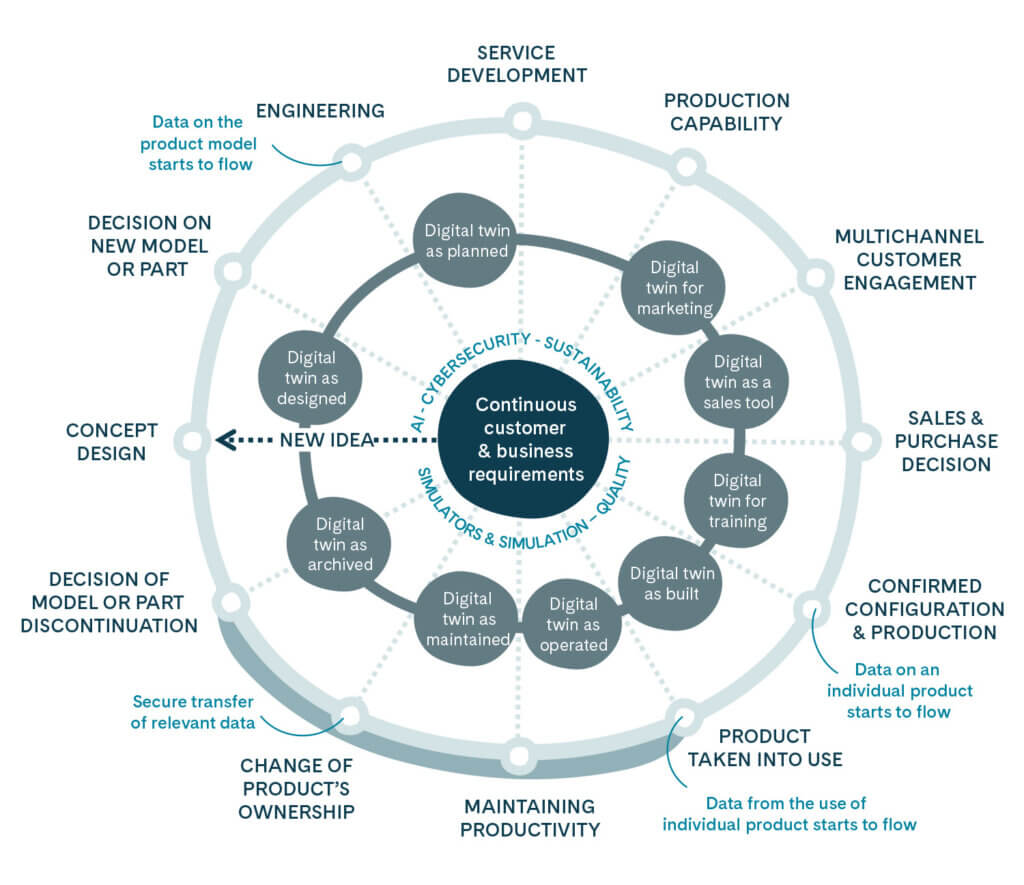
Digital Product Lifecycle model
What if you could digitally simulate and optimise every stage of your product lifecycle in advance?
What is a digital twin?
Digital twin is a virtual counterpart of a physical device, system, or process that connects data generated across different stages of the product lifecycle into a unified whole. It is one of the key manifestations of the digital thread, where information flows seamlessly from ideation and concepting to product development, manufacturing, and usage.
A digital twin is not a static model, but an evolving entity whose data becomes richer throughout the product lifecycle. Digital twins have different maturity levels, and their value increases the more seamlessly they integrate across the entire lifecycle of the product.