Procurement units still carry out a great deal of work manually that AI could complete in a fraction of the time. The barrier to using AI is neither the technology nor a lack of willingness. The challenge is the absence of clear rules for its safe use. Once shared operating practices are in place, AI can be adopted more widely, and its benefits can begin to show in procurement quality, lead times and costs.
For a single public-sector tender, 10–20 documents following prescribed formats may need to be produced. Repetitive routine work takes up procurement specialists’ time, and this is precisely the kind of work for which AI is well suited. Yet few procurement units even know whether they are allowed to use it.
Why is AI not yet part of everyday public procurement?
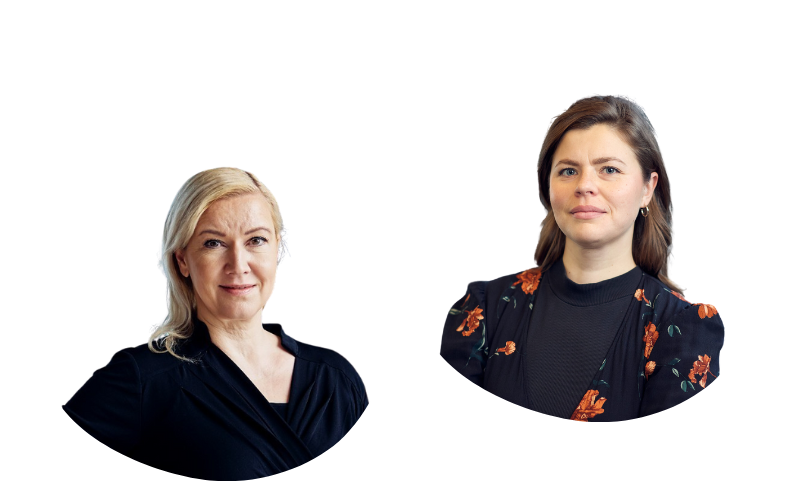
“At the moment, discussion and action are at different levels. There is a lot of talk, but it has not yet translated into everyday practice,” says Gofore’s Samuli Soini. He works on dozens of bids for public tenders every year.
Laura Ylitalo, Director of Procurement at Istekki, does not see the situation as a mystery.
“Public organisations are quite risk-averse. The culture leans more towards security than pushing boundaries,” Ylitalo says.
A focus on security is slowing the use of AI in procurement processes
There are good reasons for this focus on security. When a critical service is involved, the procurement unit must ensure its continuity and reliability by every possible means. The same caution can be seen in turnover requirements for suppliers: ultimately, these too are intended to safeguard continuity of operations.
The geopolitical situation in recent years has only reinforced this caution. According to Soini, the debate around the location of cloud services and control over data came at an unfortunate time from the perspective of AI.
“AI was very much overshadowed by security concerns. Even though safe ways of using it have been demonstrated, it takes time for them to work their way through organisations,” Soini says.
AI can bring routine procurement tasks within the scope of automation
There are many stages in the procurement process where AI is well suited. Ylitalo lists a few examples:
- supporting market research
- describing the subject matter of the procurement and defining requirements
- summarising market dialogues
- proofreading documents
- checking for inconsistencies between appendices
- verifying that tenders comply with the invitation to tender
- drafting procurement decisions and procurement reports.
What all these tasks have in common is their structured nature. Documents need to contain specific information in a particular format, and the task itself can be explained to another person in just a few sentences.
“AI is at its best in tasks that you could explain to the colleague sitting next to you,” Soini says.
Istekki is preparing to pilot an off-the-shelf market solution for low-value procurements. The aim is not only to improve the quality of the process and its outcomes, but also to alleviate resource shortages.
Cost savings do not come from AI itself, but from what you do with it
Ylitalo points out that AI does not generate cost savings by itself. After all, AI is only a tool.
“AI is not a value in itself; what matters is what you are trying to achieve with it. The objective might be a shorter schedule, a lower price or better quality,” Ylitalo says.
“If a task takes a person three working days but only three hours with AI, that is where the efficiency comes from. This also needs to be reflected in the price,” Ylitalo says.
In this situation, the current procurement model no longer works. When procurement focuses on an expert’s hourly rate, pricing is based on time spent rather than what is actually achieved. According to Soini, the model does not accommodate AI well.
“If the hourly rate is the only criterion, it does not enable the adoption of AI,” Soini says.
How can AI be used to rethink competitive tendering in public procurement?
An alternative approach is to procure based on the desired outcome. In this model, the problem is described thoroughly and the constraints and schedule are defined, but suppliers are given the freedom to propose a solution. According to Soini, this does not require the procuring organisation to have deep ICT expertise. Instead, it needs to be able to describe the problem and the environment for which the solution is being sought.
Another way AI can affect costs relates to the number of bids received. Today, even large ICT tenders typically attract only two or three bids, despite the fact that thousands of ICT companies operate in Finland.
Soini says that research shows each additional bid also lowers the price. When annual procurement volumes exceed one billion euros, even percentage-point differences matter.
Ylitalo points out that not all ICT procurement can be treated in the same way. Expert services attract plenty of bids, while off-the-shelf systems naturally attract fewer. The more specific the need, the smaller the pool of potential suppliers.
“When you want something new and tailored, it makes sense to harness the innovative power that exists within a large group of suppliers – including smaller and newer companies,” Ylitalo says.
Agents are coming, but not as the first step
Agentic AI can independently carry out chains of tasks, and in the future it will also transform procurement processes. In public-sector procurement, however, the use of agentic AI is still some way off.
“You cannot jump two carriages ahead on the AI train. You have to go through the entire journey and understand where AI can help and where it cannot,” Soini says.
According to Soini, the sequence is as follows: first, rules for safe use; then, a safe way to develop solutions; and finally, someone to maintain the environment. Only then should agents be built on top of that foundation.
Once the foundations are in place, there are natural roles for agents within the procurement process, such as compiling materials, cross-checking documents and comparing bids against the organisation’s own criteria and constraints.
Responsibility does not shift to the machine
Ylitalo prefers to think of AI as supportive intelligence rather than artificial intelligence.
“Responsibility always lies with people for what is done and what the documents say,” Ylitalo says.
She hopes that procurement processes will not become conversations between AI systems in the future, where the buyer uses AI to create the invitation to tender, the supplier uses AI to prepare the bid, and the buyer then uses AI to make the decision.
“Procurement is done by people for people. We cannot outsource ourselves from the process.”
A lack of enthusiasm is not what is holding procurement professionals back from adopting AI. According to Ylitalo, they are happy to embrace anything that makes the process smoother and improves quality. Using AI simply requires learning, support, permission to experiment and leadership that sets clear objectives. In other words, it should not be a series of isolated deployments, but should be based on an understanding of what the organisation aims to achieve with AI tools.
Where to start: using AI in the procurement process
For an individual procurement specialist, the first step towards adopting AI can be very straightforward. Soini recommends starting by experimenting with AI in everyday work: choose a low-risk, repetitive task and let AI handle, for example, the first stage. Everyday use quickly demonstrates that the key to getting good results from AI is how the question is formulated – in other words, prompting.
At organisational level, the starting point is different. Without a shared operating model, AI experiments remain isolated and cannot be scaled. Ylitalo emphasises that organisations should have a broader understanding and model of what they want to achieve with AI and what constraints should govern its use.
As a Finnish partner, Gofore builds AI governance models for public-sector organisations, establishing clear rules for safe use before tools are adopted more widely. Gofore also has its own team of procurement lawyers, which means that the model can be developed specifically from a procurement perspective rather than simply as a general set of guidelines.
Change management is integrated into the development of governance models, because new tools will not change anything without people who adopt and use them.
Soini also points out that there is no reason for every public authority to reinvent the wheel.
“We need to move away from the idea that everyone should do this alone, using their own resources.”