Is AI a better leader than a human? More efficient? More logical? More impartial? And if AI is a better leader than a human being, what role will human leadership play in the future of work?
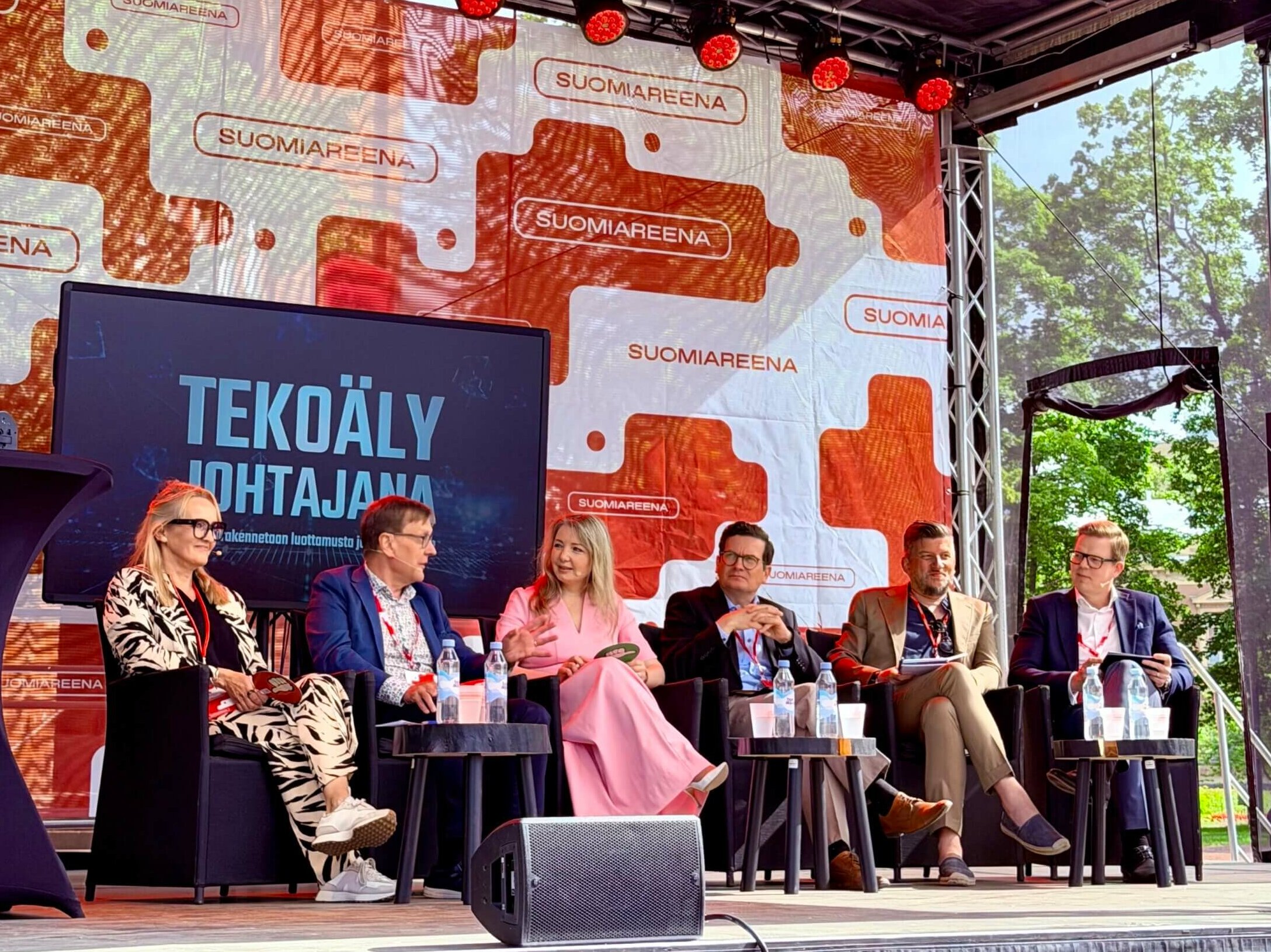
At SuomiAreena in Pori, Haaga-Helia hosted a fascinating panel discussion titled AI as a Leader. The discussion was part of Haaga-Helia’s RoboBoss research project, exploring how AI is reshaping Finnish working life and who gets to define its ethical ground rules.
After receiving a kind invitation to participate this discussion, I gathered some of the key questions raised during the panel, and sparking thoughts taking shape through the joint discussion.
In addition to myself, the panelists were Jens Wiklund (Danske Bank), Ulla Broms (Foibekartano), Atte Jääskeläinen(Sitra), Kaius Niemi (Miltton Group) and Anna Lahtinen (Haaga-Helia University of Applied Sciences). The panel was moderated by Saara Hassinen from Healthtech Finland. My warm thanks to Haaga-Helia University of Applied Sciences for the invitation, and to my fellow panelists for a high-quality and thought-provoking discussion!
1. Can AI be a better leader than a human?
The strengths AI brings to leadership are not a matter of opinion – they are a fact.
AI can manage things, perhaps more efficiently than people can. It does not forget, become overloaded, get tired or lose its nerve. Its tolerance for pressure is virtually limitless. AI is consistent, because its actions are not shaped by random illogicality or decisions made on instinct alone.
AI also takes data-driven leadership in everyday work to the next level. It processes, structures and compares vast amounts of data in the blink of an eye. AI-based decisions are grounded in information and analysis rather than intuition, which means it can produce data-led recommendations faster and more consistently than a human. In some organisations – such as platform economy businesses – systems are, in practice, already managing operations.
Used well, AI can be seen as making humans better decision-makers.
AI therefore does not merely challenge leadership. It also forces us to redefine what leadership actually means. And that reveals a bigger question: is leadership simply about making decisions based on facts and data?
Probably not.
2. AI’s weaknesses and the concerns we humans have
AI may appear to be a better leader in environments where efficiency and optimisation dominate. But efficiency is not the same as good leadership.
From a leadership perspective, the greatest challenge with AI is not technological but human. AI does not hesitate, soften its message or explain itself away. At the same time, it lacks something essential to responsible leadership: it does not feel responsibility. No shame. No guilt. No need to put mistakes right. Without these qualities, leadership can easily become clinical optimisation.
Three key concerns came up in the panel:
- Narrower abilities to participate – People may feel their ability to influence decisions is limited when they are faced with recommendations generated by AI.
- Fear of surveillance – AI technology is often associated with tight control.
- Misunderstanding trust – Trust can emerge quickly, but it also remains superficial.
3. People will continue to lead people
When AI takes on analysis and optimisation, what remains is what has always been at the heart of leadership: combining uniquely human qualities such as emotional intelligence, intuition, strategic thinking and empathy to move an organisation forward and overcome the challenges it faces.
Some of the essential tools include:
Ethics: Making morally sound choices – and taking responsibility for them – remains a human task. This requires an understanding of interpersonal dynamics, cultures, values and norms, and often the ability to read between the lines.
Culture: Leadership is about recognising and building culture and the things that connect people. These cannot be outsourced to an algorithm or machine learning. One way to think about this is to ask: who would want to work in an organisation where the culture was both created and monitored by AI?
Trust: Trust does not arise only from the right decisions, but from the experience that a leader is on your side and working for the common good.
Humanity: AI can simulate emotions, but it cannot experience them. This distinction is decisive when comparing AI-based leadership with human leadership.
Leadership will not disappear, but it will become polarised
For me, one key takeaway from the panel was this: AI will not replace human leadership. But it will do something far more significant to leadership: it will help distinguish poor leadership from good leadership. As analysis and decision-making become automated, mediocre leadership will quickly be exposed. Efficiency alone will no longer be enough. Human skills that cannot be outsourced or faked will move to the centre of leadership.
AI’s role in leadership seems to be twofold: on the one hand, leaders must adopt new ways of working in order to lead organisations that consist of both people and AI. On the other hand, there is an interesting and multi-layered future vision in which AI itself could take on a leadership role.
Leadership is, above all, about setting direction and carrying responsibility. It is about making meaningful, broad-minded decisions that build a path towards the future. Leadership is therefore about creating meaning and bringing people along.
AI may therefore be better at structuring and optimising. Humans remain better at engaging people and building bridges between things.
The future of leadership cannot be reduced to the question of who leads better – humans or AI. The real question is whether leaders can combine AI’s strengths with their own uniquely human capabilities, and whether they dare to be genuine, approachable and still visionary guides for their people. This is leadership practised in everyday life, not in prompts.