
Artificial Intelligence (AI) is rapidly changing the way we work, collaborate, and innovate. To better understand how these tools are being adopted across our organisation, we recently conducted a survey among our software development teams.
With 232 responses (roughly 13 % of our employees or said otherwise 40 % of people working in software development), the results offer a valuable snapshot of current trends, benefits, and challenges in AI adoption.
The purpose of the survey was to gain deeper insight into the real state of AI usage in software development across our organisation. Internal conversation tends to focus on handful of highly enthusiastic individuals and either remarkable success stories or cautionary tales. This narrative can distort our understanding of who is using AI tools etc. By this survey we aimed to clarify patterns and inform our ongoing strategy.
Key highlights
The survey responses are mainly from Software Developers and Technical Project Managers, with a strong focus on Software Development, Data & AI, and Architecture service areas. There is a broad but concentrated representation across roles, business areas, and service areas.
- Widespread adoption: 78 % of respondents use AI tools at least weekly, with most relying on them daily. This signals a strong embrace of AI across roles and business areas.
- Boosting productivity: 87 % of participants report that AI tools have made them more productive, helping them work faster and more efficiently. Only a small minority saw no benefit or a decline in productivity.
- Positive outlook, cautious approach: While most users feel optimistic about AI, there is a healthy dose of caution – especially around quality, trust, and security. This is important to us and is in line with our culture and values.
- Top tools in use: The most popular AI tools are Microsoft 365 Copilot, ChatGPT, and GitHub Copilot. Other tools mentioned include Cursor, Ollama, Google Gemini, Anthropic Claude, and JetBrains AI Assistant.
- Growing skills and projects: Data shows a steady increase in both the number of projects using AI tools and the number of employees developing expertise in these platforms.
What is working well
AI tools are helping our teams overcome the “blank canvas” problem, sparking creativity and accelerating routine tasks. Many users recommend these tools for their ability to streamline workflows and support innovation.
Respondents are generally moderately satisfied with AI tools, have a cautious but not high level of trust in the correctness of AI-generated content, and perceive the quality of that content as average to good. Extreme ratings (very low or very high) are less common, reflecting a balanced but critical user perspective.
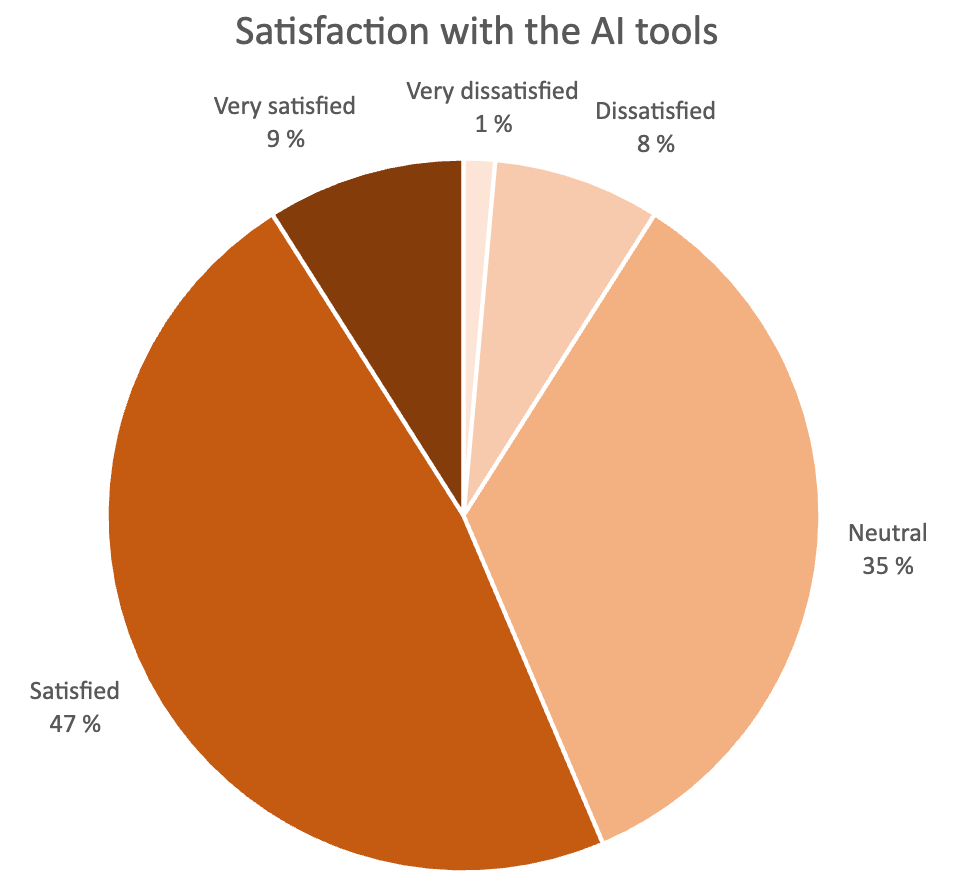
Most respondents are likely to recommend AI tools and see them as beneficial, especially for improving productivity. However, concerns about security, trust, and over-reliance are common. Many users call for better training and clearer guidelines, and while the future impact of AI is expected to be significant, it is also seen as something that needs to be managed thoughtfully.
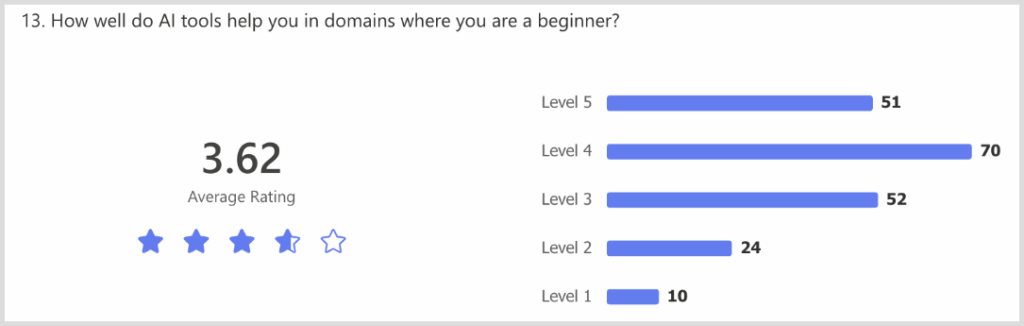
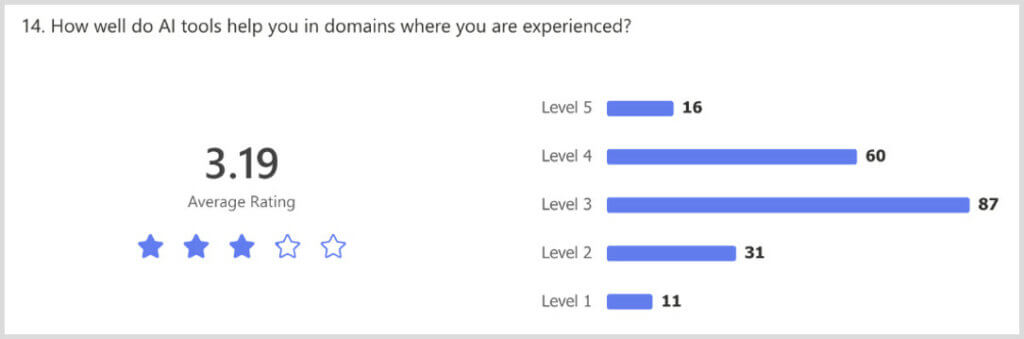
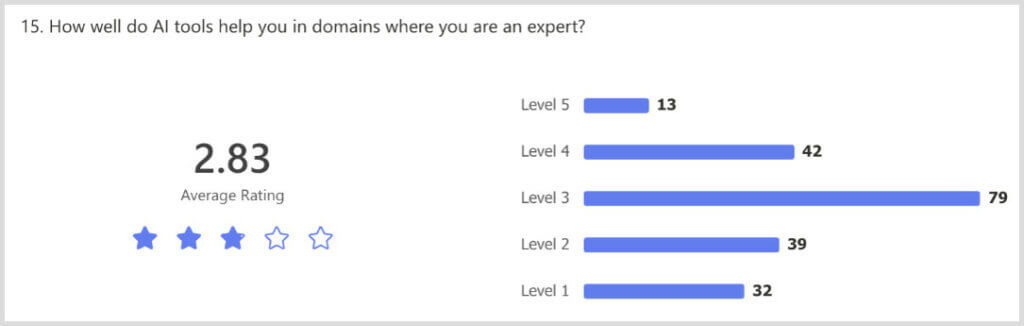
Survey reveals that the more experienced you are in a domain, the less helpful AI tools seem to become. Nevertheless, even in domains where one is an expert, people still see AI tools as helpful. The more experienced you are, the less helpful AI tools may become, or rather, the less incremental value they tend to provide. As we can see from the charts, beginners get a lot more help from AI tools than more experienced ones.
Challenges and opportunities
Despite the enthusiasm, several challenges remain:
- Security and privacy: Protecting sensitive data is a top concern. Employees are mindful of the risks of sharing information with public AI models and are seeking clear guidelines for safe usage.
- Training needs: Teams are asking for practical, domain-specific training to bridge the gap between AI “hype” and real-world application.
- Quality control: Some users caution against over-reliance on AI, emphasising the need for human oversight to ensure accuracy and maintain high standards.
Looking ahead
The survey underscores the transformative potential of AI in our work, but also highlights the importance of thoughtful management, ongoing training, and robust security practices. As we continue to expand our use of AI, we’re committed to supporting our teams with the resources, guidance, and safeguards they need to succeed.
The survey and its findings have been compiled by Pekka Kokkonen, Antti Honkanen, Teemu Erkkola, Saara Honkonen, Johanna Nousiainen, and Juhana Harmanen.