
Our 2025 Developer Project Radar results are out – fresh from the oven and served with visualisations by our talented designers. This time, we improved the way we collect and filter project data, making this the most accurate Project Radar we’ve produced to date. The sample includes developers only from our Finnish subsidiary, though, so it omits international units and the recent Huld acquisition. Let’s dive right in!
Download the Developer Project Radar 2025 results (PDF).
Developer Project Radar results
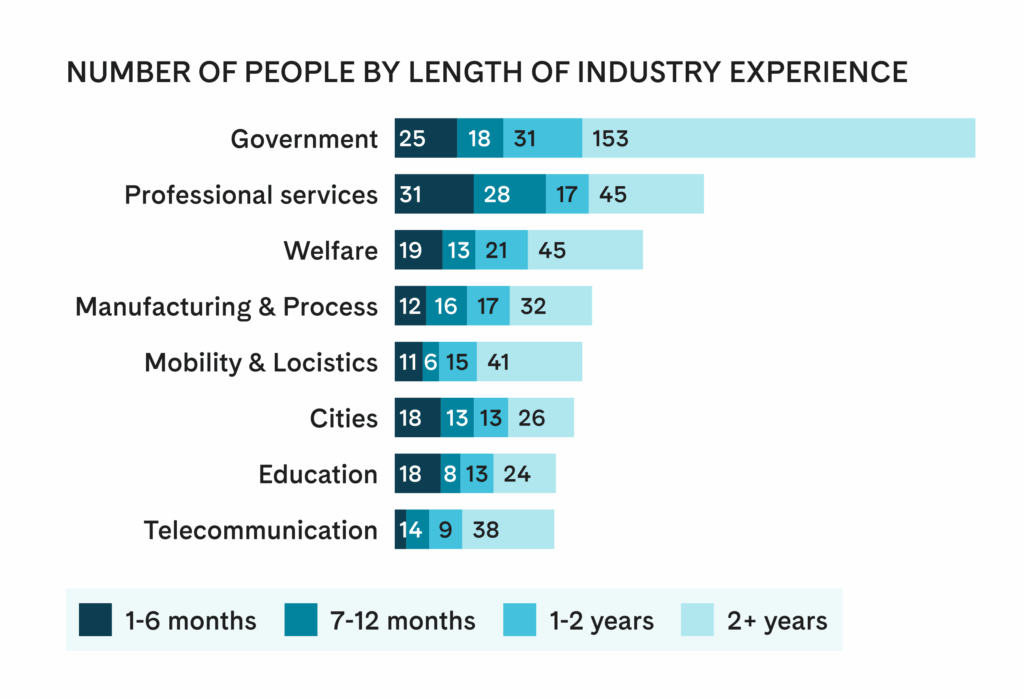
The biggest new feature in our Project Radar is the addition of industry-specific data. We have categorised all our customer projects to provide a more comprehensive view of the industries our experts have worked in.
Historically, we have extensive experience in sectors such as government, cities, and welfare services, but as the data shows, our experts’ knowledge is not limited to public-sector domains, as intelligent industry has been one of our strategic focus areas. Starting this year, our acquisition of Huld will strengthen our offering in the defense and space industries as well. Supporting our experts in developing deeper, industry-specific understanding is an important part of creating a better overall developer experience at Gofore.
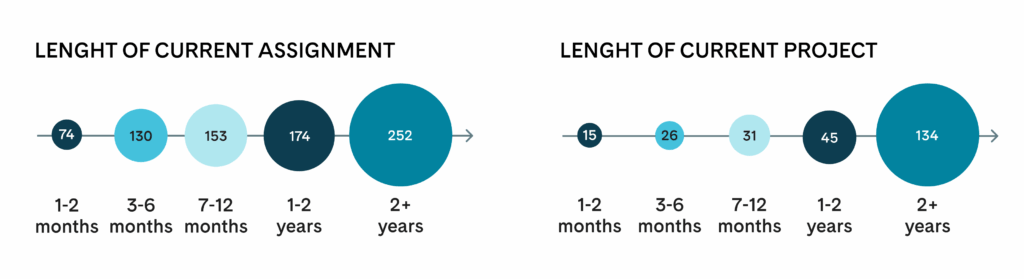
Despite tightening budgets and growing competition, developers’ workloads have not become more fragmented since the previous survey. In fact, shorter 3–6-month projects have decreased, while long-term projects lasting more than two years have become more common.
The same pattern appears in day-to-day work: most Goforean developers focus on a single project at a time, and only a small minority juggle more than two. This stability reflects our operating model. Gofore builds strategic, long-term partnerships with its customers, which allows our developers to concentrate on solving complex problems and, in doing so, grow into trusted advisors within their projects.
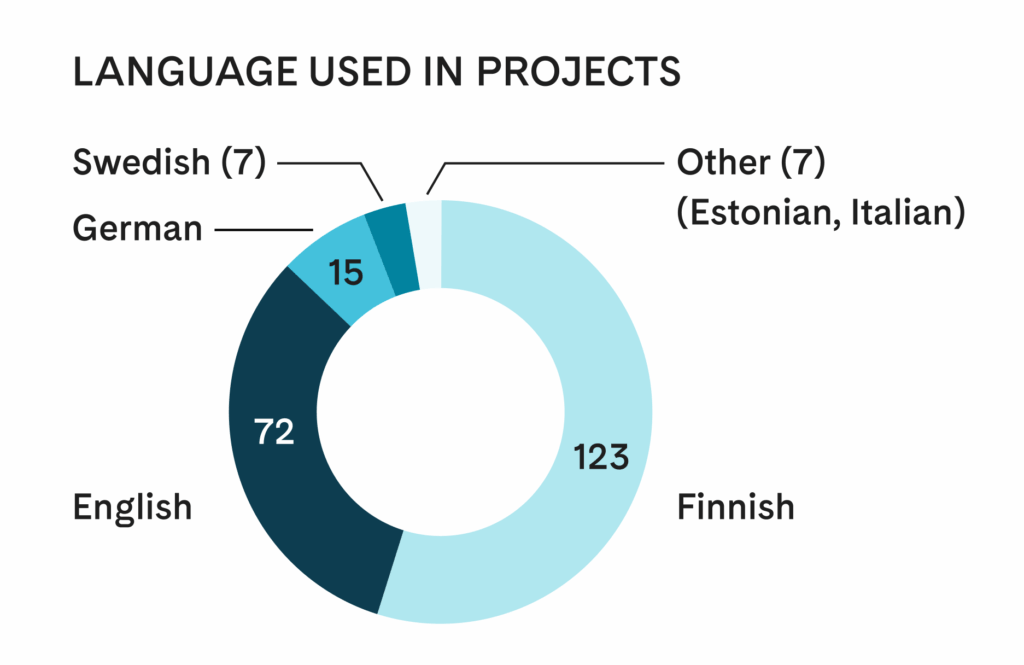
On the language front, project opportunities in German and Swedish have increased, but the most significant growth has been in Finnish-language projects, partly at the expense of English-language ones. Even with this shift, Gofore continues to employ experts in over twenty cities across Finland and Europe, and also offers fully remote assignments. The small, but hopefully growing minority of other languages includes Estonian, French, Portuguese, and Italian. Che bello!
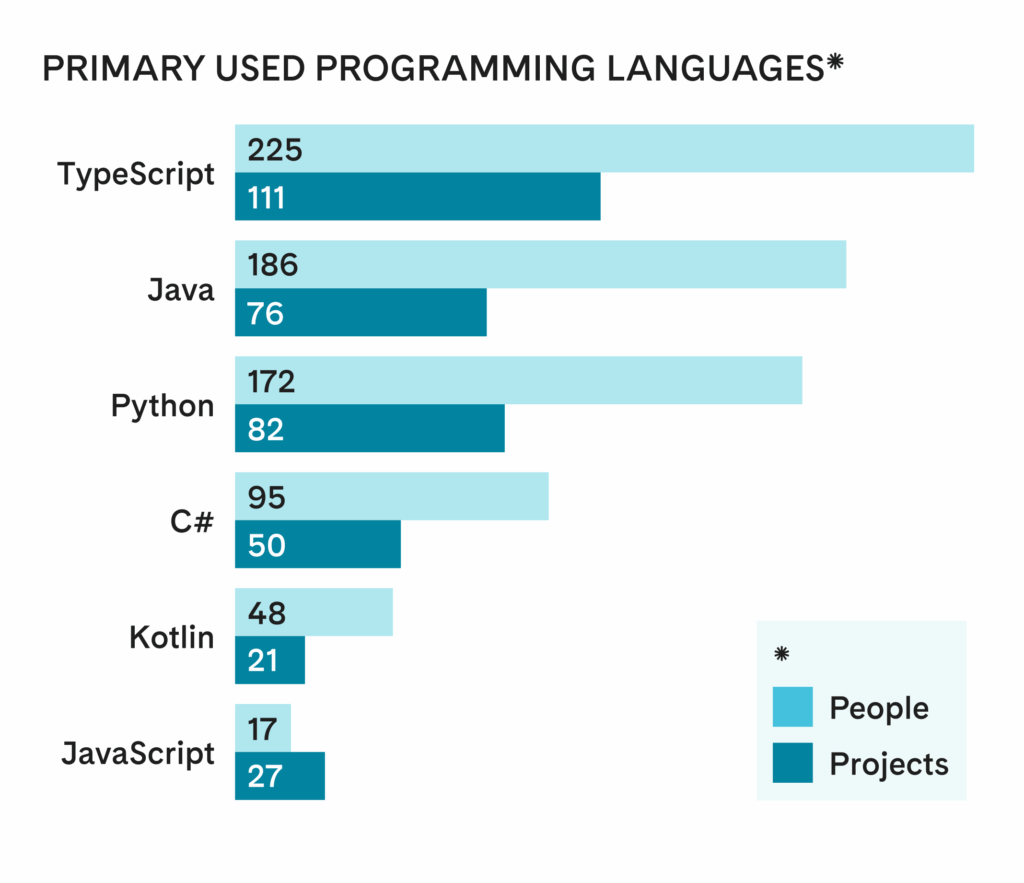
Unlike natural languages, programming languages are universal – but their popularity is not. One clear trend in our projects is the shift from plain JavaScript to TypeScript. This stands in contrast to the 2025 Stack Overflow Developer Survey, where TypeScript trails far behind JavaScript. Demand for Java continues to surpass that of both Python and C# in Goforean projects. Globally, Python is far ahead of the other two, which are pretty much tied in popularity among professional developers.
While these are the most popular languages, there are definitely interesting things that won’t make the charts. Have you worked with CICS, Structured Text, or QML? Some of our experts have!
In frontend technologies, React still reigns supreme, followed by Angular and Vue.js. The number of people working with React in their projects is roughly the same as all other frameworks combined. This reflects a global trend, which also draws criticism from some experts who would like to see more thorough discussion about technology choices, rather than defaulting to any particular framework. While the three big modern frameworks take home most of the cake, legacy stacks continue to feature jQuery and AngularJS. They’re the programming world’s equivalent of fanny packs: never entirely going out of style, even if they probably should.
Node.js remains the most used backend technology in project environments, while Spring Boot takes second place. The gap between second and third is so large that even if we combine .NET Core projects with older .NET Framework projects, their total still doesn’t reach the number of Spring Boot projects.
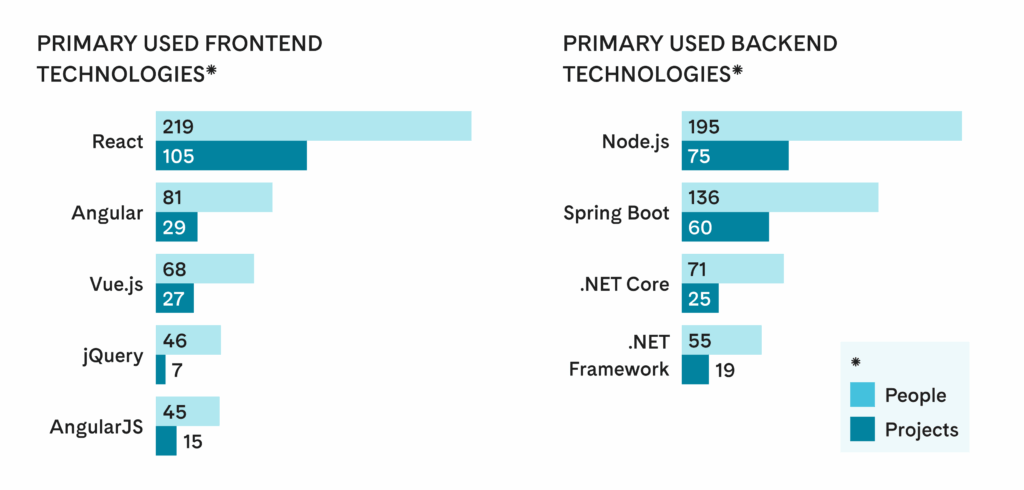
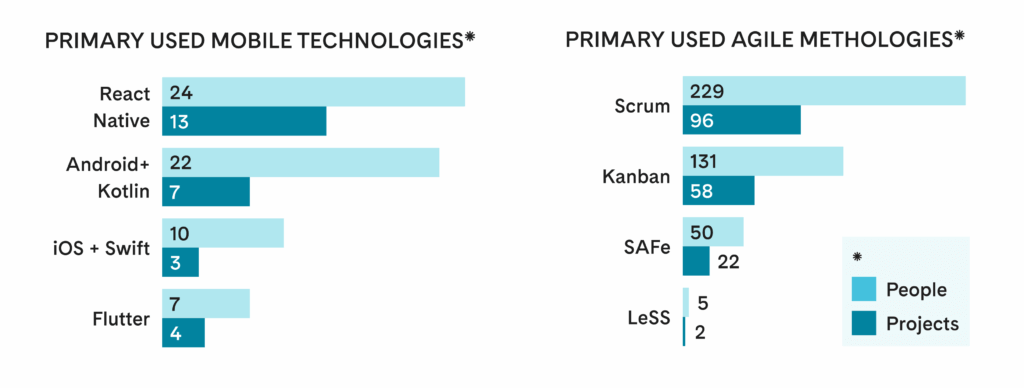
In mobile development, React Native holds the crown as the most widely used toolset, with its new architecture mitigating many known issues and improving developer experience. It’s our recommended toolset for most new projects, and many customers also know to request it, recognising it as a cost-effective solution. While Kotlin and Swift native apps remain the right choice for specific use cases, Progressive Web Apps (PWAs) have nearly disappeared from the landscape, with Flutter now in fourth place among mobile project technologies.
In agile methodologies, Scrum is the clear frontrunner, followed by Kanban. SAFe remains the most widely used scaling framework, particularly popular among those working on large public-sector projects. The only other scaling framework to appear in the data is Large-Scale Scrum (LeSS), though its usage is rare. Other frameworks such as Nexus or Agile@Scale do not appear in the results at all.
I hope this peek into a developer’s life at Gofore was interesting!